July 21, 2026
The best hurricane tree prep in Northwest Florida happens between December and May, before the season opens on June 1. Have a certified arborist inspect for structural defects, prune to reduce wind resistance using thinning cuts rather than topping, remove trees that show root damage or trunk decay, and cable trees with weak unions worth saving. Laurel oaks, water oaks, and sand pines fail most often in Gulf storms, while healthy live oaks are among the most wind-resistant trees in the region. Waiting until a storm is named leaves no time for safe, quality work.
In This Article
- Which trees should be pruned before hurricane season
- Which species fail most often in Gulf hurricanes
- The signs a tree may not survive the season
- Why does topping make trees more dangerous, not less
- A prep checklist for Pensacola and Pace homeowners
- When should prep work be scheduled
Key Takeaways
- Hurricane season runs from June 1 to November 30, with the peak from mid-August through October.
- Schedule structural pruning in winter or spring. Crews book solid once a storm enters the Gulf.
- Laurel oaks, water oaks, and sand pines are the most failure-prone species locally.
- Healthy live oaks are among the most wind-resistant trees in the South.
- Never top a tree for “hurricane safety.” It creates weakly attached regrowth that fails faster.
- Trees growing in groups survive hurricanes better than isolated trees.
Hurricane Prep by the Numbers
- Hurricane season: June 1 to November 30, peaking August 15 to October 15.
- Hurricane Ivan (2004) and Hurricane Sally (2020) both put hurricane-force winds directly over Escambia and Santa Rosa Counties.
- University of Florida post-hurricane research found live oaks among the highest survivors, while sand pine and laurel oak ranked among the worst.
- A mature laurel oak often begins internal decline at 40 to 50 years, right when it’s at maximum size over your roof.
- Quality pruning takes weeks to schedule in spring. After a named storm forms, wait times stretch to months.
Why This Matters in Northwest Florida
Pensacola, Pace, and the rest of Northwest Florida sit on one of the most hurricane-exposed stretches of the Gulf Coast. Ivan and Sally were not flukes; they were the pattern. Our sandy, often saturated soils give roots less anchorage than the clay soils further north, and the region’s fast growth means subdivisions in Pace and Milton are full of fast-growing, weak-wooded species planted for quick shade. Add long, wet summers that feed root rot, and a tree that looks fine in April can be a projectile by September. The trees and hurricanes research from University of Florida IFAS Extension, built on surveys after ten Florida hurricanes, is the foundation for everything below.
What Trees Should Be Pruned Before Hurricane Season?
Prioritize in this order:
- Trees over targets. Anything with major limbs over the house, driveway, pool enclosure, or power drop comes first.
- Trees with defects. Co-dominant trunks with included bark, overextended limbs, dense end-heavy canopies, and previous breakage points.
- Large-maturing trees that have never been structurally pruned. Young oaks shaped now fail far less for decades.
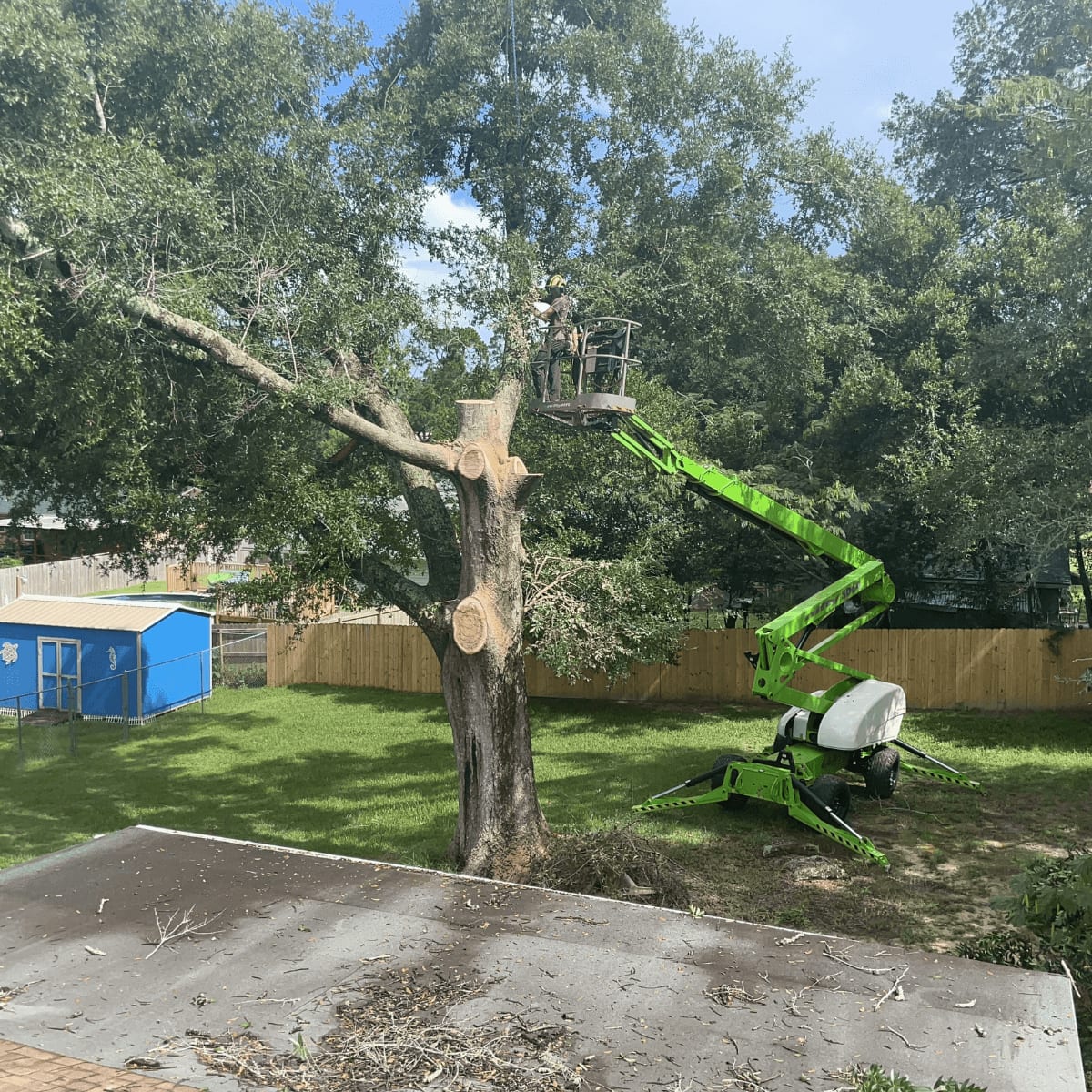
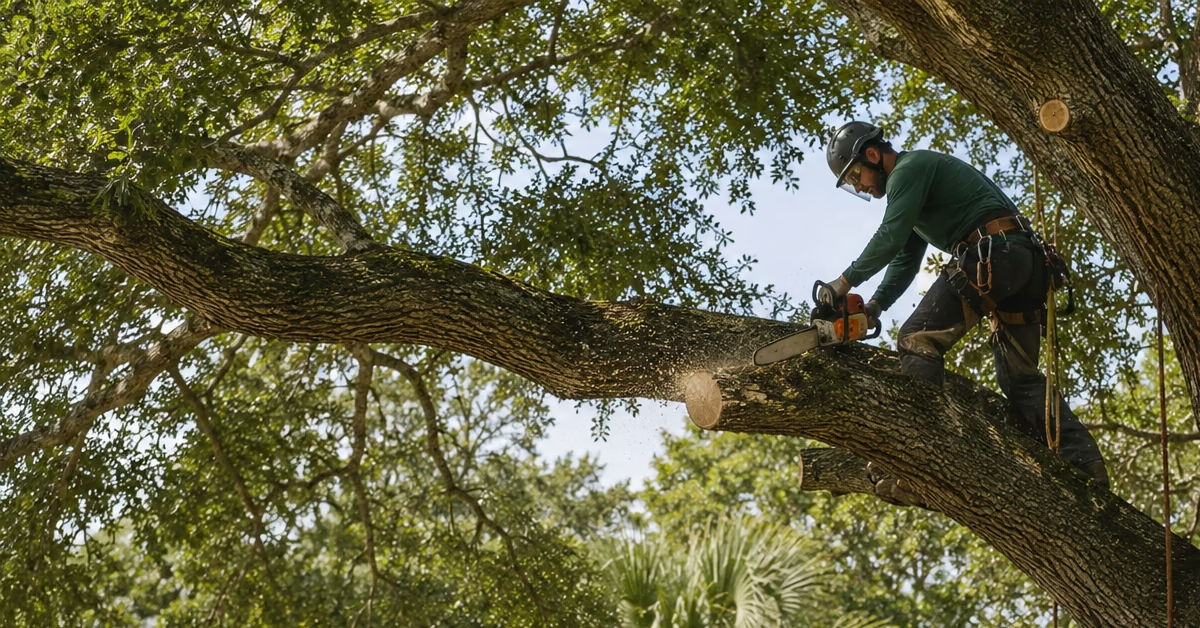
The goal is reducing wind load and removing weak points: thinning the canopy so wind passes through, shortening overextended limbs back to laterals, and removing deadwood. This is exactly what our tree trimming crews do in the off season, and why we push customers to book it before June.
What pruning is not: topping, lion-tailing (stripping interior branches so only tufts remain at the tips), or “hurricane cuts.” All three concentrate wind load at the worst points and trigger weakly attached regrowth. UF/IFAS research found lion-tailed and topped trees fail at higher rates, not lower.
Which Trees Are Most Likely to Fail During Hurricanes?
| Species | Wind Performance | Common Failure Mode |
| Live oak | Among the best | Rarely fails when healthy |
| Southern magnolia | Good | Limb shedding |
| Bald cypress | Good | Rarely uproots |
| Longleaf pine | Moderate | Snapping in extreme wind |
| Slash/loblolly pine | Moderate to poor | Trunk snap mid-stem |
| Water oak | Poor | Decay-driven trunk failure |
| Laurel oak | Poor | Splits at co-dominant unions, decays early |
| Sand pine | Worst | Uproots and snaps |
Laurel and water oaks deserve special mention because Pensacola and Pace yards are full of them. They grow fast, get huge, and begin decaying from the inside decades before the canopy shows it. A large water oak leaning over a bedroom is the single most common pre-season removal we recommend.
Signs a Tree May Not Survive Hurricane Season
- Mushrooms or shelf fungus (conks) on the trunk or root flare
- A new lean, or soil lifting on one side of the root zone
- Dead limbs over 4 inches in diameter in the upper canopy
- Cracks where two trunks meet, or seams of included bark
- Carpenter ants streaming from a cavity, a reliable sign of internal hollowness
- Construction within the last 5 years that trenched or compacted the root zone
Any one of these is grounds for a professional tree risk assessment. Our ISA-certified arborists rate the actual likelihood of failure and the target it would hit, then give you options: prune, cable and brace, or remove. Florida law (Statute 163.045) also relies on this documentation if a dangerous residential tree needs to come down.
What We Commonly See in the Field
One of the most common calls we receive comes in late August, when a storm has a name and a cone: “Can you take down the big oak over my house this week?” By then, every reputable crew in Escambia and Santa Rosa County is booked, and the work that does happen gets rushed. The homeowners who fare best in our experience are the ones who walk the yard with an arborist in winter, fix the two or three real problems for a fraction of panic pricing, and spend storm week worrying about shutters instead of trees. The other pattern competitors rarely mention: more than half the “hurricane damage” removals we do after a storm show pre-existing decay at the failure point. The storm didn’t pick a random tree. It picked the weak one.
Hurricane Tree Prep Checklist for Pensacola Homeowners
- Walk the property and list every tree that could reach a structure if it fell.
- Check each for the warning signs above; photograph anything suspicious.
- Book an arborist inspection between December and May.
- Complete pruning, cabling, and removals before June 1.
- Clear dead palm fronds and yard debris that becomes airborne.
- Save our emergency tree service number, (850) 999-0110, before you need it.
- After any major storm, reinspect. Partial root failure often shows up one storm later.
The Florida Forest Service and FEMA both list tree work among the most effective pre-storm mitigation steps a homeowner can take, and it’s one of the few that also adds property value.
What Homeowners Should Do Next
If it’s before June, schedule the inspection now and beat the rush. If a storm is already approaching, focus on what’s achievable: deadwood removal, securing loose yard items, and documenting your trees with photos for insurance. If a tree is clearly failing with a storm inbound, call us; we triage genuine hazards first.
Common Questions About Hurricane Tree Prep
When should I prune my trees before hurricane season in Florida?
December through May is ideal. It gives wounds time to seal, lets crews work without storm pressure, and avoids the booked-solid months once the season starts.
Should I remove all the tall trees near my house?
No. Healthy, wind-resistant species like live oak often protect homes by buffering wind. Remove based on condition and species, not height alone. An assessment separates the assets from the hazards.
Do pine trees survive hurricanes?
It varies by species. Longleaf pines perform reasonably well, slash and loblolly snap mid-trunk in strong storms, and sand pines perform worst of all. A tall pine within striking distance of a house deserves a professional look.
Is topping a tree a good way to make it hurricane-safe?
No. Topping removes the tree’s natural structure and triggers fast, weakly attached regrowth that fails at lower wind speeds. Proper thinning and reduction pruning achieve the goal without the damage.
Will insurance pay for tree removal before a storm?
Generally no. Preventive removal is the homeowner’s cost, but it’s a fraction of post-storm emergency removal plus a roof claim. Some insurers do require documented mitigation on older policies.
What wind speed brings trees down?
Compromised trees can fail in 40 to 60 mph gusts, which Northwest Florida sees in ordinary summer thunderstorms. Healthy, well-structured trees routinely ride out far stronger wind. Condition matters more than the category.
Get Storm-Ready While the Gulf Is Quiet
Every hurricane season, the same lesson repeats across Pensacola, Pace, and Milton: the yards that come through clean are the ones that did their tree work in the off-season. The Gulf gives no useful warning. By the time a storm has a name, your options have already narrowed.
Walk your property this week. If anything on the checklist above gives you pause, contact D’s Trees or request a free estimate. Our certified arborists serve Pensacola, Pace, and all of Northwest Florida.