
July 22, 2026
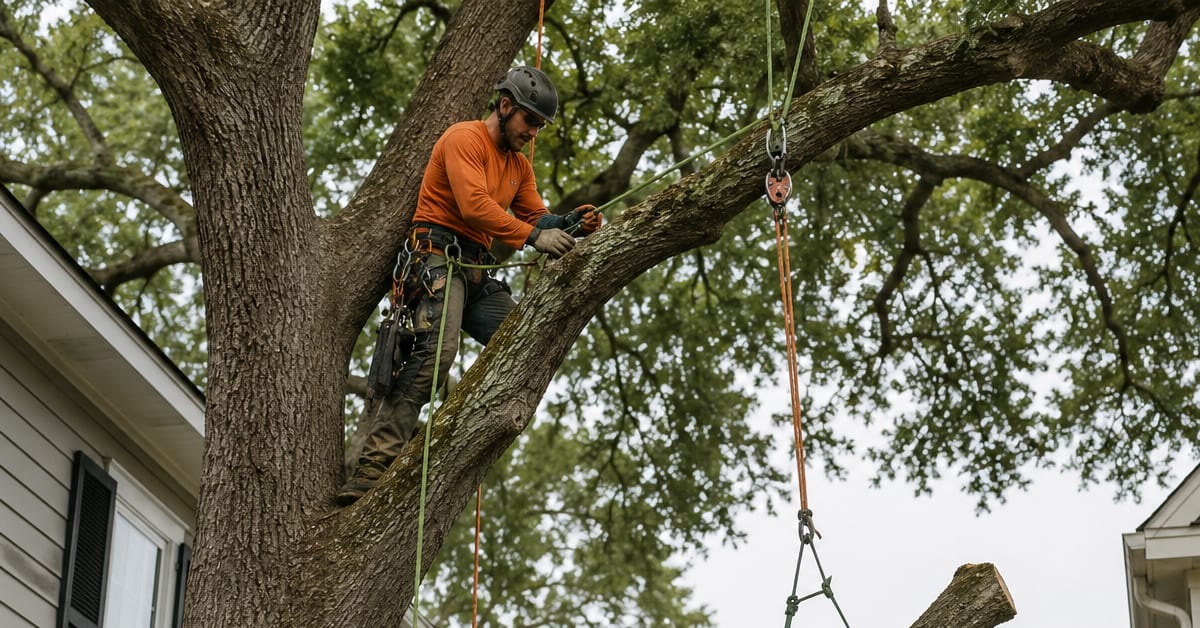
A tree is “near a structure” the moment any part of it could reach the structure if it failed, which means a 70-foot water oak 50 feet from your house is still a strike-zone tree. Removing trees in that zone is controlled dismantling, not felling: every piece is rigged or craned down in sections sized to what the crew and equipment can safely manage. In Pensacola’s older neighborhoods, where big laurel and water oaks stand over small lots, crane-assisted removal is often safer and cheaper overall than traditional climbing. The biggest risk factor isn’t the tree. It’s hiring a crew without the rigging skill the job demands.
In This Article
- How close is too close for a tree near a house
- Why dense neighborhoods multiply the difficulty
- What actually goes wrong on tight-space removals
- Crane removal versus traditional climbing, compared honestly
- The signs a tree near a structure should come down
- What we see in Pensacola’s older neighborhoods
- How to prepare before removal day
Key Takeaways
- The strike zone is the tree’s full height plus margin in every direction. Most “far enough” trees aren’t.
- Near structures, trees come down in rigged sections, never felled whole.
- The most common removal damage isn’t dramatic. It’s crushed irrigation, cracked driveways, and rutted lawns from poor planning.
- Cranes lift sections up and away instead of swinging them over the roof, which is why house-side jobs favor them.
- Decay changes everything: hollow wood can’t hold rigging anchors, and only an assessment finds that out in advance.
- Verify insurance specifically for tree work. General liability that excludes arboriculture is common and worthless to you.
Tree Removal Near Structures by the Numbers
- Strike zone math: a 70-foot tree owns a 70-foot-plus radius. Few city lots escape it.
- Sections rigged over a roof are typically a few hundred to a couple thousand pounds each, calculated, not guessed.
- A crane job that takes 4 hours often replaces 2 days of climbing and lowering.
- Water and laurel oaks, the most-removed species near Pensacola homes, frequently begin internal decay at 40 to 50 years old.
- One under-sized cut or mis-set rigging point is all it takes; there is no minor mistake over a roof.
When Mature Oaks Outgrow the Space Around Them
Pensacola’s older neighborhoods grew up under fast trees on small lots. The result, decades later, is mature water oaks and laurel oaks standing within strike distance of nearly every roof from East Hill to Brent, many entering the decay-prone phase of their lifespan at full size. Hurricane seasons like Ivan and Sally proved what happens when those trees are left to fail on their own schedule. Removing them before the Gulf does it is routine work for a properly equipped crew, and genuinely dangerous work for anyone else.
How Close Is Too Close for a Tree Near a House?
Run the simple test: imagine the tree hinging at the ground and falling in any direction. If any arc touches the house, garage, pool enclosure, or the neighbor’s anything, it’s a strike-zone tree and removal is precision work. Distance from the trunk matters less than people think; lean, canopy weight distribution, prevailing wind exposure, and root condition determine where a tree actually goes when it fails. That’s also why “it leans away from the house” is false comfort. Storm winds rotate, and root-plate failures drop trees against the lean. A tree risk assessment answers the real question, which is not how close the tree is, but how likely it is to fail and what it would hit.
Why Tree Removal Gets More Complicated in Dense Neighborhoods
On open land, gravity does the work. Between houses, every force must be controlled: each limb is roped, every section’s weight estimated against the rigging gear’s working load, and the drop zone might be a strip of lawn eight feet wide between a fence and a gas meter. Add overhead service drops, septic fields that can’t carry equipment, neighbors’ property lines crossing the canopy, and shallow utilities under the staging area, and the planning takes longer than the cutting. The International Society of Arboriculture treats rigging and tight-space dismantling as its own discipline within the ANSI Z133 safety standard, and it’s the part of the trade where experience shows most.
What Can Go Wrong During a Tight-Space Removal?
The failures we get called to fix follow a pattern. A section cut oversized for the rigging swings into the roofline. A rigging point set in decayed wood tears out under load. A pickup-truck crew drops a limb “mostly” where they meant to, through a pool screen. Equipment crosses a soft lawn and crushes the irrigation main. And the quiet one nobody mentions: the uninsured crew’s injury becoming the homeowner’s liability problem. The USDA Forest Service consistently identifies tree work among the most hazardous occupations in America, and the gap between professional and improvised work is widest exactly where your house sits.
Crane Removal vs Traditional Tree Removal
| Factor | Crane-Assisted | Traditional Climb & Rig |
| How sections move | Straight up and away | Lowered on ropes through the canopy |
| Best for | Trees over structures, decayed trees, no drop zone | Sound trees with workable lowering space |
| Time on site | Hours | Often days |
| Risk to structures | Lowest available | Managed but higher |
| Decayed or storm-damaged trees | Strongly preferred; climber stays off bad wood | Sometimes unsafe to climb at all |
| Cost | Higher hourly, often lower total | Lower hourly, more crew-hours |
The honest summary: when a tree overhangs a structure, carries decay, or has no lowering zone, crane service usually wins on safety and total cost. We covered the decision in depth in Cranes vs. Chainsaws: why certain trees require specialized equipment.
Signs a Tree Near a Structure Should Be Removed
- Mushrooms or conks on the trunk or root flare
- A new or worsening lean toward the structure
- Major deadwood over the roofline
- A crack at a trunk union, especially with included bark
- Hollow sound or visible cavity in the lower trunk
- Storm damage that left half a canopy and new cracks
- A high-failure species (water oak, laurel oak, sand pine) in visible decline over a target
Any of these next to a house deserves a professional call, and under Florida Statute 163.045, an ISA arborist’s documentation of danger lets you remove it without local permitting delays. If it’s already failing, our emergency tree service answers around the clock.
What We Commonly See in Older Pensacola Neighborhoods
One of the most common calls we receive from East Hill, North Hill, and Brent goes like this: a beautiful 60-year-old water oak shades the whole front yard, and the homeowner has been quoted everything from suspiciously cheap to alarmingly high with no explanation of the difference. Here’s the difference. The cheap quote plans to free-drop wood into a yard that can’t absorb it and hopes. The real quote prices a crane day, protection for the driveway and irrigation, a rigging plan for the lead over the porch, and stump grinding afterward. The thing competitors rarely say out loud: in these neighborhoods, the trees are usually hollow somewhere. We sound every stem before a climber commits weight to it, because the most dangerous assumption in this trade is that old wood is solid wood.
What Homeowners Should Do Before Removal Begins
- Get the scope in writing: sections, equipment, property protection, debris, stump, and final grade.
- Ask for proof of liability insurance and workers’ comp specifically covering tree work.
- Walk the access route with the crew and flag irrigation, septic, and utilities.
- Notify neighbors if the canopy or staging crosses the line.
- Clear vehicles and patio furniture from the work zone the night before.
- Confirm who calls the utility if service drops are involved. It should be the contractor.
Common Questions About Tree Removal Near Structures
How much does it cost to remove a large tree close to a house in Pensacola?
More than the same tree in open yard, because every piece must be controlled. Crane jobs concentrate cost into hours instead of days and frequently come in lower overall for house-side oaks. Honest pricing requires a site visit.
Can a tree be removed if it’s leaning over my roof?
Yes. Overhang and lean are exactly what sectional and crane removal are built for. Sections are lifted up and away rather than dropped, so the roof is never in the path.
Will the removal damage my yard?
A professional crew protects surfaces with mats, plans equipment routes, and prices restoration honestly. Ruts and crushed irrigation are planning failures, not inevitabilities.
Do I need my neighbor’s permission if the canopy crosses the property line?
You can remove your tree, but accessing their property for rigging or staging requires their OK. We coordinate this routinely; a knock on the door before equipment arrives prevents every dispute.
Is it cheaper to wait until the tree falls and let insurance pay?
No. A failure means a roof claim, a deductible, premium impacts, emergency-rate removal, and weeks of repairs. Planned removal is a fraction of that, and D’s Trees offers no-money-upfront insurance billing when storms do strike first.
How long does a removal near a house take?
Crane-assisted: typically half a day to a day. Traditional rigging on a large oak: one to three days depending on access and the tree’s condition.
The Tree Won’t Pick a Convenient Time. You Can.
Every hurricane season, Pensacola homeowners discover the difference between a removal they scheduled and a removal the weather scheduled for them. The first is a controlled morning’s work. The second comes with a roof claim attached.
If a tree is standing too close to something you can’t afford to lose, contact D’s Trees for an assessment, or request a free estimate. We remove strike-zone trees across Pensacola and all of Escambia and Santa Rosa Counties.