July 21, 2026
An ISA-certified arborist starts at the ground, not the canopy: root flare, soil condition, and trunk base reveal more about failure risk than green leaves ever will. The assessment scores how likely the tree is to fail, what it would hit, and how severe the result would be, then ranks fixes from pruning and cabling up to removal. In Florida, this documentation matters legally: under Statute 163.045, an ISA-certified arborist’s risk report lets a homeowner remove a dangerous residential tree without a local permit. Most assessments in Pace and Santa Rosa County take under an hour per tree.
In This Article
- What an arborist checks in the first five minutes
- What turns an ordinary tree into a high-risk failure candidate
- Warning signs hiding behind a healthy-looking canopy
- How trees near homes, driveways, and power lines are judged differently
- What we find most often on local assessments
- When saving a tree beats removing it, and when it doesn’t
- How to prepare before the arborist arrives
Key Takeaways
- Green leaves prove a tree is alive, not that it’s sound. Those are different questions.
- The root flare and lower trunk predict whole-tree failure better than anything overhead.
- What the tree would hit matters as much as whether it will fail.
- Mushrooms or conks on the trunk or roots are a structural alarm, not a cosmetic issue.
- Florida Statute 163.045 makes an ISA arborist’s documentation the key to permit-free removal of dangerous residential trees.
- A good assessment saves trees as often as it condemns them.
Tree Risk Assessments by the Numbers
- A residential assessment takes 30 to 60 minutes per tree.
- ISA’s Tree Risk Assessment Qualification (TRAQ) follows the ANSI A300 Part 9 standard.
- Decay can hollow more than half a trunk’s cross-section before the canopy thins.
- Roots extend 2 to 3 times the canopy width; construction damage anywhere in that zone counts.
- Laurel and water oaks, the most common large yard trees in Santa Rosa County, often begin internal decline at 40 to 50 years old.
Why Tree Risk Is Different in Santa Rosa County
Pace and the surrounding county grew fast, and so did the trees planted around every new slab. Thousands of homes now sit under mature laurel oaks, water oaks, and pines at exactly the age when internal decay accelerates. Add sandy soil with weak root anchorage, a high water table that drives shallow rooting, and hurricane-force winds that have crossed this county repeatedly, and the question is never whether some trees fail. It’s which ones, and whether anyone checked first.
The First Things an ISA-Certified Arborist Notices
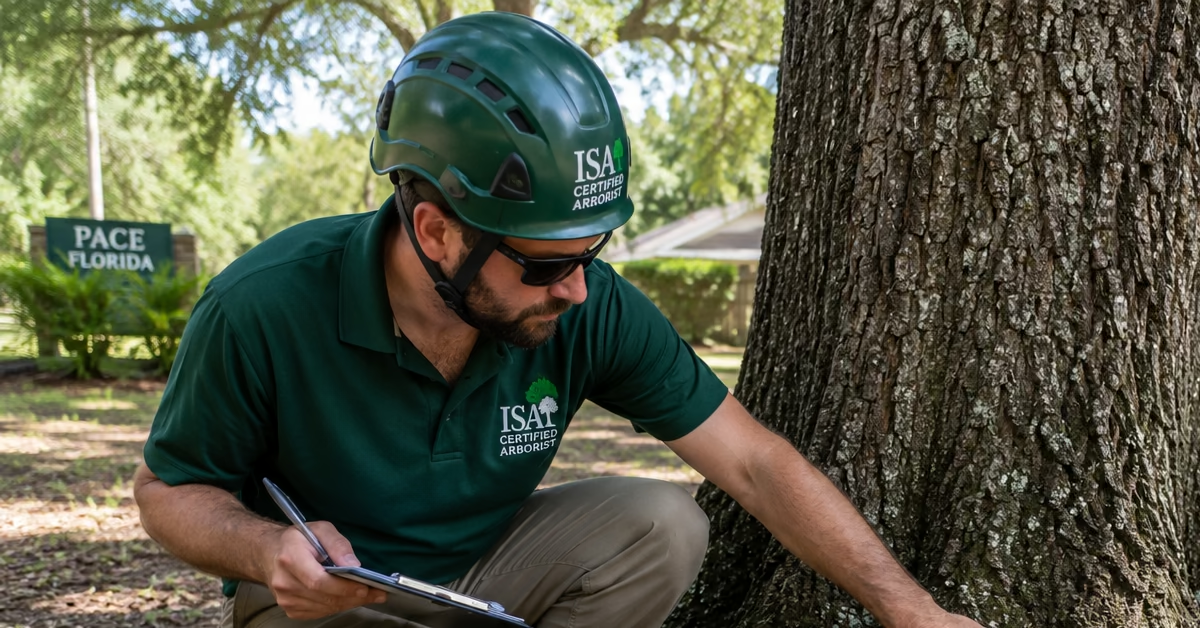
Before touching the tree, a trained assessor reads the site: recent trenching, a new driveway over the root zone, grade changes, irrigation lines, lightning scars on neighboring trees. Then the inspection runs ground to crown.
The flare comes first. A trunk that enters the soil straight, with no visible flare, means buried or girdled roots. Heaving soil or a fresh lean means the root plate is moving. Fungal fruiting at the base means decay has reached the structure that holds everything else up. Certification through the International Society of Arboriculture trains assessors to weight these ground-level signals heavily because root and butt failures are the ones that put whole trunks on houses.
What Makes a Tree a High-Risk Failure Candidate?
| Risk Factor | Why It Matters |
| Co-dominant trunks with included bark | The most common defect in local oaks; looks like strength, behaves like a crack |
| Decay fungi (conks, mushrooms) | Internal hollowing with little outside evidence |
| Root zone disturbance within 5 years | Failure often lags construction by several seasons |
| Overextended horizontal limbs | Leverage multiplies wind and gravity loads |
| Previous topping | Regrowth attaches weakly and fails young |
| Species profile | Laurel oak, water oak, and sand pine fail at far higher rates than live oak |
| New lean | An active structural change, not a quirk |
One factor rarely sinks a tree. Stacked factors do, especially with a target underneath.
Signs a Tree May Be Unsafe Even If It Looks Healthy
A tree’s living tissue sits just under the bark, so the outer shell can photosynthesize a full green canopy while fungus consumes the middle. Watch for what the leaves can’t tell you: shelf conks or mushrooms at the base, a seam or crack where two trunks meet, carpenter ants trailing from a cavity, sawdust-like frass at the base, bark sloughing off in sheets, and dead limbs over 4 inches up high. The University of Florida IFAS Extension documents the decay fungi common in Gulf Coast hardwoods, and several show almost nothing externally until late stage. One sign deserves a phone call. Two deserve an inspection before the next storm system.
How Arborists Evaluate Trees Near Homes, Driveways, and Power Lines
Risk is failure multiplied by consequence, so the same defect earns different ratings over a bedroom than over a back fence. Under the TRAQ method, the assessor scores likelihood of failure, likelihood of impact, and severity, then assigns a rating from low to extreme. A hollow oak over open lawn might rate moderate and get monitored. The same oak over a driveway where kids load up for school every morning rates high and gets action. Power lines add another layer: work near energized conductors is restricted to qualified crews, and an arborist will flag when the utility must be involved before anyone climbs. We walked through a real local example in our case study on preventing property damage through timely risk assessment.
What We Commonly Find During Tree Risk Assessments
One of the most common calls we receive starts with “the tree looks fine, but my insurance company wants it checked.” More often than not, the insurer’s instinct is right about the wrong tree. The homeowner worries about the tall pine out front; we find the real problem in the backyard water oak with a conk line nobody noticed behind the shed. The other pattern competitors rarely mention: we talk people out of removals constantly. Roughly as many assessments end with “your tree is sound, here’s a pruning plan” as end with a removal recommendation. An assessment from a company that only sells removals tends to find removals. Ask who is inspecting and what credential they hold.
When a Tree Can Be Saved and When Removal Makes More Sense
Worth saving: sound trunk with a correctable defect, such as a weak union that cabling and bracing can support, end-heavy limbs that reduction pruning can lighten, or early-stage root problems that excavation can correct.
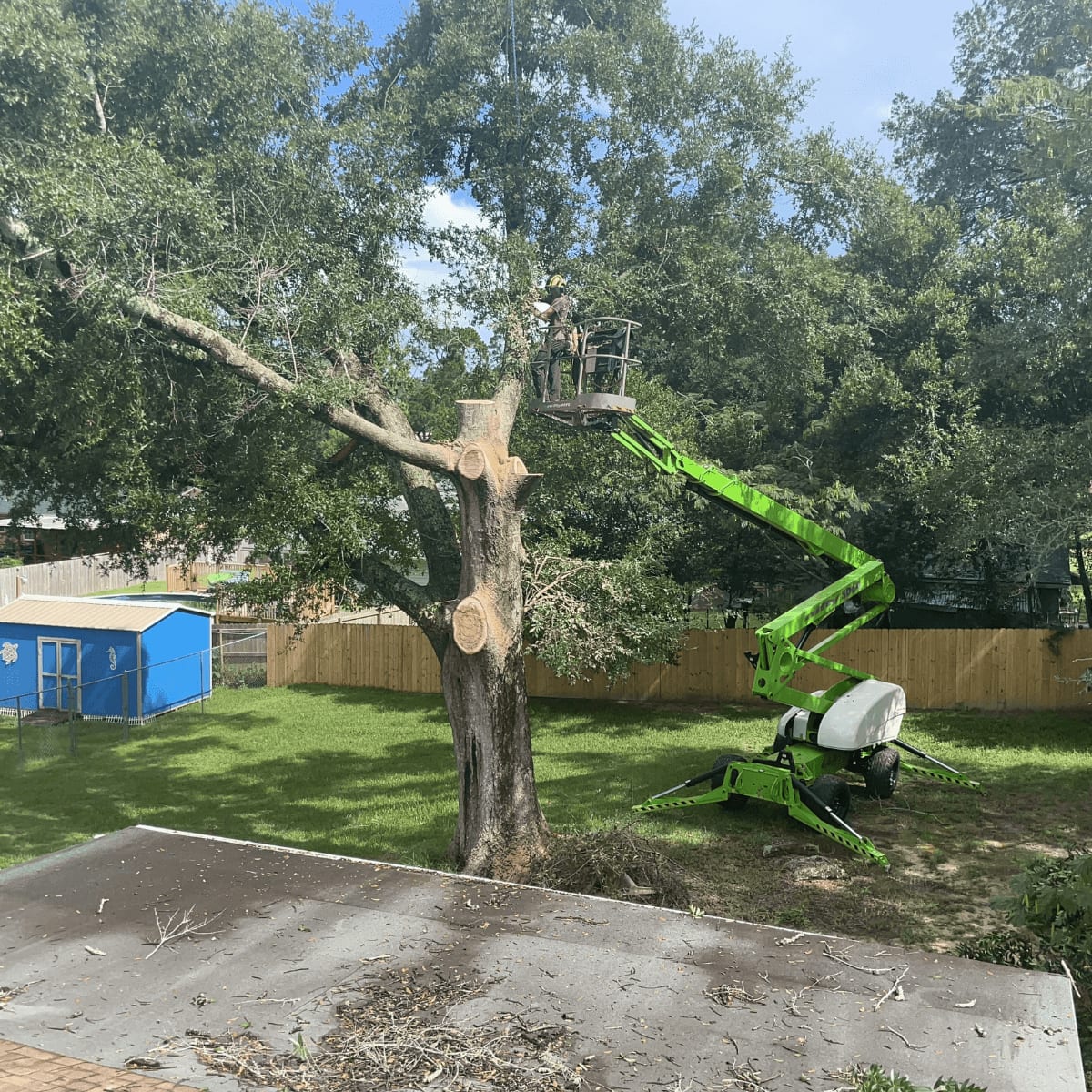
Removal makes more sense: advanced decay in the lower trunk or roots, a new and progressing lean, a failed union into the main stem, or a high-risk species in decline over a high-value target. When that’s the verdict, tree removal with proper rigging or a crane is the safe path, and under Florida Statute 163.045 our written documentation lets you skip the local permit process for a genuinely dangerous residential tree. Where a permit is still required, our municipal permits service handles it.
What Homeowners Should Do Before Scheduling an Assessment
- List every tree that could reach the house, driveway, or play area if it fell.
- Photograph anything that concerns you, including the base, not just the canopy.
- Note the history: construction, lightning, past limb failures, when symptoms appeared.
- Clear access to the trunk so the flare is visible.
- Have your goal ready: peace of mind, insurance documentation, pre-purchase check, or a removal decision.
Then schedule an arborist consultation. Inspections book fastest December through May, before hurricane season.
Common Questions About Tree Risk Assessments
What does an ISA certification actually require?
Documented field experience, a proctored exam covering tree biology, biomechanics, diagnosis, and safety, plus continuing education to keep the credential current. It’s the industry’s baseline for credible risk advice.
How much does a tree risk assessment cost in Santa Rosa County?
Typically a modest flat or hourly fee depending on tree count and whether you need a written report. It costs far less than an unnecessary removal, and far less than a preventable failure.
Can an arborist tell if a tree is hollow without cutting into it?
Usually yes. Sounding, decay indicators, and fungal fruiting patterns reveal a great deal. Where certainty matters, resistance drilling or sonic tomography can map the internal wood.
Do I need a permit to remove a dangerous tree in Florida?
Often no. Under Florida Statute 163.045, a homeowner with ISA-arborist documentation that a residential tree poses unacceptable risk can remove it without a local permit, notice, or fee. The assessment must come first.
How often should mature trees be inspected?
Every 3 to 5 years for trees near structures, plus after any hurricane, lightning strike, or construction within the root zone.
Will the arborist pressure me to remove trees?
A credentialed assessment ranks options from least invasive upward. At D’s Trees, assessments regularly end in pruning plans or a clean bill of health. The report is the product, not the removal.
Know What’s Standing Over Your Roof Before the Gulf Tests It
Nearly every catastrophic failure we respond to in Pace, Milton, and Pensacola left clues a season earlier: a conk, a seam, a lean that “was always like that.” An hour with an ISA-certified arborist turns guessing into a documented answer and a plan, and it’s cheapest long before a storm has a name.
Contact D’s Trees to schedule a tree risk assessment anywhere in Pace or Santa Rosa County, or request a free estimate online.